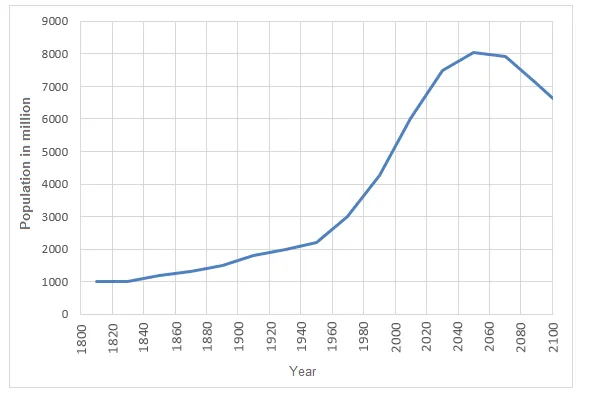
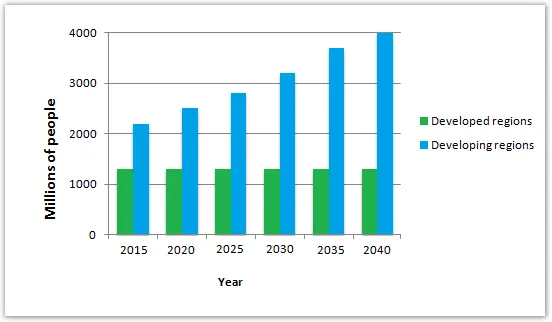
The provided illustrations depict the total global population and the urban population in various regions of the world.
At a glance, it is clear that the worldwide population has been on a steady rise, and there is a significant variation in the urban population across different global regions. The urban population in developed regions appears to be relatively stable, while it is growing in developing regions.
Delving into the details, the global population has been steadily increasing from 1800 and is projected to continue its upward trajectory until 2100. The rise is particularly sharp from 1950 onwards. In terms of urban population, developed regions such as North America and Europe have seen a slow but steady increase, with North America maintaining a slight edge over Europe.
In contrast, the urban population in developing regions such as Africa and Asia has seen a rapid surge from 1950 onwards. Asia's urban population, in particular, has skyrocketed and is projected to continue its steep ascent, surpassing all other regions by a significant margin by 2050. Africa's urban population, while still lower than the other regions, is also expected to see a substantial increase.