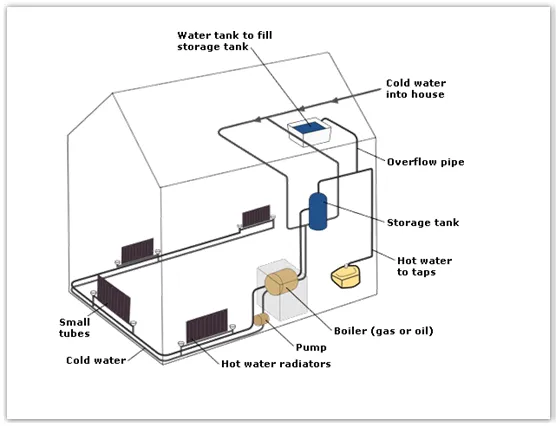
The diagram illustrates the process of how a central heating system in a residential property functions.
At a general level, it can be seen that the system is a continuous cycle that involves the heating of water, its distribution throughout the house, and its subsequent return for reheating. It is also noticeable that the system is powered by gas and that the water is heated in a boiler.
In more detail, the process begins with cold water being drawn from a tank and heated in a boiler, which is fuelled by gas from the main gas supply. The heated water is then distributed via pipes to radiators located in different rooms of the house. These radiators emit heat, thereby warming up the rooms.
Afterwards, the water, now cooled, returns to the boiler through a system of pipes. It is then reheated and the cycle continues. It is worth noting that the system also includes a pump to facilitate the movement of water around the house, and a thermostat to control the temperature of the water and, consequently, the heat output of the radiators.