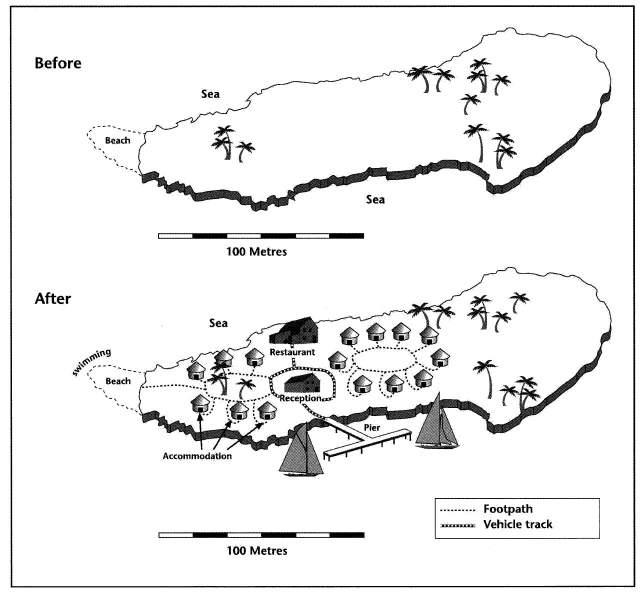
The two provided diagrams illustrate the transformation of an island due to the establishment of various tourist amenities over time.
At a glance, it is clear that the previously undeveloped island has been significantly modified to accommodate tourists, with the construction of several new facilities. The natural landscape of the island has been largely preserved, despite these changes.
In the initial layout, the island was uninhabited and its features were entirely natural, including a beach on the west, a wooded area in the center, and a few scattered trees. However, the subsequent map reveals that a pier for tourist boats has been built on the south side of the island, leading to a reception area. From there, a footpath has been created, linking the reception to the beach, where accommodations for visitors have been constructed.
Furthermore, the central forested area remains untouched, but a restaurant has been erected to the east of it. Additionally, a vehicle track now connects the reception to the restaurant. The scattered trees have been preserved, demonstrating a commitment to maintaining the island's natural beauty amidst the development.