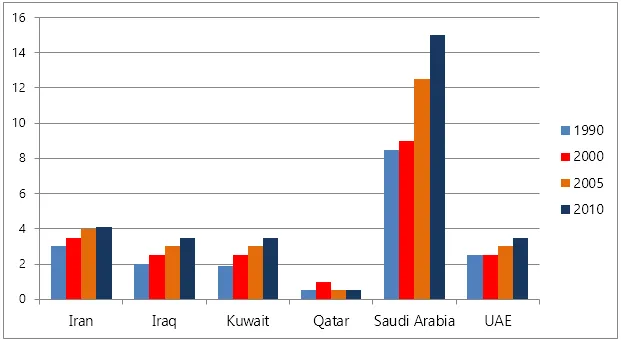
The provided diagram delineates the quantity of oil produced by six Middle Eastern nations from 1990 to 2010.
From a broad perspective, it can be observed that all the countries experienced fluctuations in their oil production over the two decades, with Saudi Arabia consistently leading in terms of output. Additionally, a general upward trend in production can be discerned, despite some intermittent drops.
Focusing on the details, Saudi Arabia's oil production began at 8 million barrels per day in 1990, peaked at 14 million in 2000, and then slightly declined to 12 million by 2010. In contrast, the UAE started with a lower production of 2 million barrels per day, increased to 4 million in 2000, and then remained relatively stable for the rest of the period.
Regarding the other four countries, Kuwait, Iran, Iraq, and Qatar, they all showed varying degrees of growth and decline. For instance, Iran's production increased from 3 million barrels per day in 1990 to 4 million in 2000, but then dropped back to 3 million by 2010. Similarly, Iraq's output fluctuated dramatically due to political instability, while Kuwait and Qatar experienced more steady growth over the 20-year period.