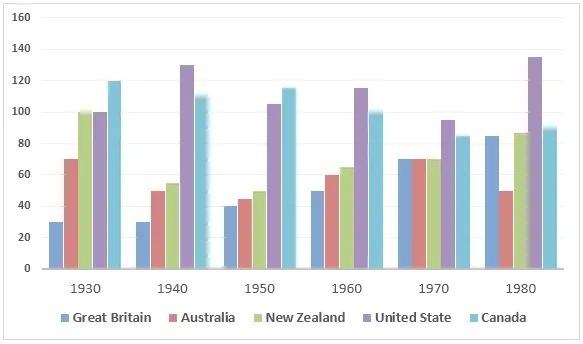
The table provides information about the number of individuals incarcerated in five different nations over a period of fifty years, from 1930 to 1980.
The most striking feature is that all five countries experienced an increase in their prison populations over the timeframe, with varying degrees of growth. In addition, the United States consistently had the highest number of prisoners throughout the period.
In 1930, the United States had the highest number of prisoners, at 30,000, followed by Canada with 12,000. The other three countries, Great Britain, Australia, and New Zealand, had significantly lower figures, ranging from 4,000 to 9,000. Over the next five decades, the number of prisoners in the United States surged dramatically to reach 130,000 by 1980.
Meanwhile, the prison populations in the other four countries also grew, but at a slower pace. For instance, Canada saw an increase from 12,000 to 27,000, while the number in Great Britain rose from 9,000 to 30,000. Australia and New Zealand experienced similar growth rates, with their prison populations reaching 15,000 and 8,000 respectively by 1980.