Speaking test #110
Part 1 · Interview
4 to 5 minutes. The examiner asks about you and familiar topics.
Can you tell me your full name?
Where are you from?
Do you work or are you a student?
Have you ever been to any old buildings in your city?
Yes, I have been to several old buildings in my city. One of my favorites is a historic church that dates back to the 19th century. The architecture is absolutely stunning and it's always a pleasure to visit.
Do you prefer to live in an old building or a modern house?
Personally, I prefer to live in a modern house. I appreciate the clean lines and open spaces that are characteristic of contemporary design. However, I do understand the appeal of living in an old building with its own history and charm.
Are there any old buildings you want to see in the future?
Yes, I would love to see the ancient pyramids in Egypt. The pyramids are one of the oldest and most incredible architectural achievements in human history, and I think it would be an amazing experience to see them in person.
Do you think preserving old buildings is important?
Definitely! I think preserving old buildings is crucial for maintaining the cultural heritage and identity of a city or country. These buildings often have a rich history and significance that can be lost if they are demolished or allowed to fall into disrepair. Additionally, they can serve as important tourist attractions and bring economic benefits to the local community.
Do you like outdoor activities?
Yes, I absolutely love outdoor activities. I find them to be incredibly invigorating and they provide an excellent way for me to stay active and healthy.
What outdoor activities do you most like to do?
I am particularly fond of hiking and camping. I love the feeling of being out in nature and the sense of adventure that comes with exploring new trails and wilderness areas. I also enjoy swimming, kayaking, and rock climbing.
How much time do you spend outdoors every week?
I try to spend as much time outdoors as possible, but it can vary depending on my schedule. On average, I would say that I spend around 20-25 hours per week outdoors.
What (types of) outdoor activities are popular in your country?
In my country, there are many different types of outdoor activities that are popular. Some of the most popular include hiking, camping, rock climbing, and watersports such as swimming, kayaking, and rafting. Additionally, there is a strong culture of outdoor sports such as soccer, basketball, and volleyball. In the winter, skiing and snowboarding are also popular outdoor activities. Overall, there is a wide range of outdoor activities for people to enjoy in my country.
You will have to talk about the topic for one to two minutes. You have one minute to think about what you are going to say. You can make some notes to help you if you wish.
Describe a common transportation system in your city
You should say:
- What type of transportation system it is
- How people use this transportation system
- Advantages of this transportation system
- Any improvements you would suggest for this transportation system
What type of transportation system it is
In my city, one of the most common transportation systems is the metro rail. The metro system is a modern, efficient, and convenient mode of transportation that connects various parts of the city through an extensive network of underground and elevated rail lines. It is a rapid transit system that significantly eases the daily commute for thousands of people in the city.
How people use this transportation system
The majority of people in my city use the metro rail system to travel to work, school, or other destinations within the city. The trains are usually punctual and offer a faster alternative to navigating the city's notorious traffic congestion. Many commuters find the metro system to be a cost-effective and time-saving option compared to other modes of transportation like buses or private cars.
Advantages of this transportation system
One of the key advantages of the metro rail system is its contribution to reducing traffic congestion and air pollution in the city. By encouraging more people to use public transportation, the metro helps in decreasing the number of private vehicles on the roads, thus leading to a cleaner and greener environment. Moreover, the metro provides a safe and comfortable travel experience for passengers, with air-conditioned coaches and modern facilities.
Any improvements you would suggest for this transportation system
While the metro rail system in my city is commendable, there is always room for improvement. To further enhance the efficiency of the system, authorities could consider expanding the existing network to cover more areas and neighborhoods within the city. Additionally, incorporating advanced technology for ticketing and train scheduling could help in reducing waiting times and enhancing the overall passenger experience. Overall, with continuous upgrades and expansions, the metro rail system can continue to be a vital lifeline for urban transportation in my city.
- Words
- 280
- Sentences
- 13
- Words per sentence
- 21.5
- Speaking time
- about 2.2 min
Counted at 130 words a minute. The exam gives you one to two minutes.
Part 3 · Discussion
4 to 5 minutes. The examiner asks broader questions linked to the cue card topic.
What are the differences between buses and cars in cities?
Public transportation and private transportation in urban areas serve different purposes and cater to different needs. Public transport, like buses and trains, is generally more cost-effective and can accommodate a larger number of passengers, which makes it an ideal option for those looking to save money or reduce their carbon footprint. On the other hand, private transportation, such as cars or motorcycles, offers unparalleled convenience and flexibility, allowing individuals to travel on their own schedule without the constraints of fixed routes or timetables. However, while private vehicles can be more comfortable and personalized, they often contribute to traffic congestion and air pollution in densely populated cities. Ultimately, the choice between the two often comes down to personal preferences and circumstances, like distance, budget, and time constraints. Both modes of transport have their unique advantages and challenges, which makes the transportation landscape in urban areas quite fascinating!
Some people think that taking public transport is better than driving your own car. What do you think about this?
I absolutely agree that public transportation can often be more efficient than relying on personal vehicles. For one, it significantly reduces traffic congestion, which is a huge issue in many urban areas. When more people opt for buses or trains, it alleviates the burden on the roads, allowing for smoother travel for everyone. Moreover, public transport is usually more environmentally friendly, as it emits fewer pollutants per passenger compared to individual cars. In a world increasingly focused on sustainability, investing in public transit systems is not just practical but also essential for our future.
How important do you think a good transportation system is for a city's growth?
A reliable transportation system is absolutely paramount for the development of a city. It not only facilitates the movement of people but also enhances economic activities by ensuring goods can be transported efficiently. When public transport is dependable, it encourages individuals to use it, which in turn reduces traffic congestion and minimizes pollution. Moreover, a well-connected city attracts businesses and tourists alike, boosting the local economy. Ultimately, a robust transportation network lays the groundwork for a city to thrive and grow sustainably.
Why do you think some people like taking public transport instead of driving their own cars?
I think there are several compelling reasons why some individuals opt for public transport instead of driving their own cars. For one, using public transport can be significantly cost-effective, as it often saves on expenses like fuel, parking fees, and maintenance costs associated with owning a vehicle. Additionally, many people appreciate the opportunity to reduce their carbon footprint by choosing more sustainable modes of travel, especially in an era when environmental concerns are paramount. Moreover, public transport allows for a certain level of convenience; commuters can use their travel time to catch up on reading, listen to podcasts, or even relax, rather than dealing with the stress of traffic jams. Lastly, in densely populated urban areas, public transport systems can be much more efficient, enabling individuals to navigate through the city quickly without the hassle of finding parking. Overall, these factors make public transport an attractive choice for many.
How could the way people get around in cities change in the next ten years?
The transportation system in cities is likely to undergo significant transformation in the next decade, driven by technological advancements and a growing emphasis on sustainability. We might see an increased reliance on electric vehicles and autonomous driving technology, which would not only reduce emissions but also enhance safety on our roads. Moreover, urban planners are likely to prioritize public transportation networks, integrating them with smart city technologies to make commuting more efficient. Additionally, the rise of micro-mobility solutions, like e-scooters and bike-sharing programs, could become more prevalent, offering residents flexible and eco-friendly alternatives to traditional transport. Overall, I believe that the transportation landscape will become more interconnected and user-friendly, ultimately promoting a more sustainable urban lifestyle.
What steps could be taken to get more people to use public transport?
To encourage more people to use public transportation, cities could implement a variety of innovative initiatives. For starters, enhancing the frequency and reliability of public transport services can make a significant difference; when people know they won’t be left waiting for long periods, they’re more likely to opt for buses or trains. Additionally, offering subsidized fares or even free travel during peak hours could attract a larger user base. Furthermore, creating more integrated transport systems that connect different modes of transport seamlessly can also encourage usage; for example, ensuring that metro stations are conveniently linked to bus stops. Lastly, launching awareness campaigns that emphasize the environmental benefits of public transit can inspire a shift in mindset, encouraging people to see it as a viable and responsible alternative to driving.
Go further with the books
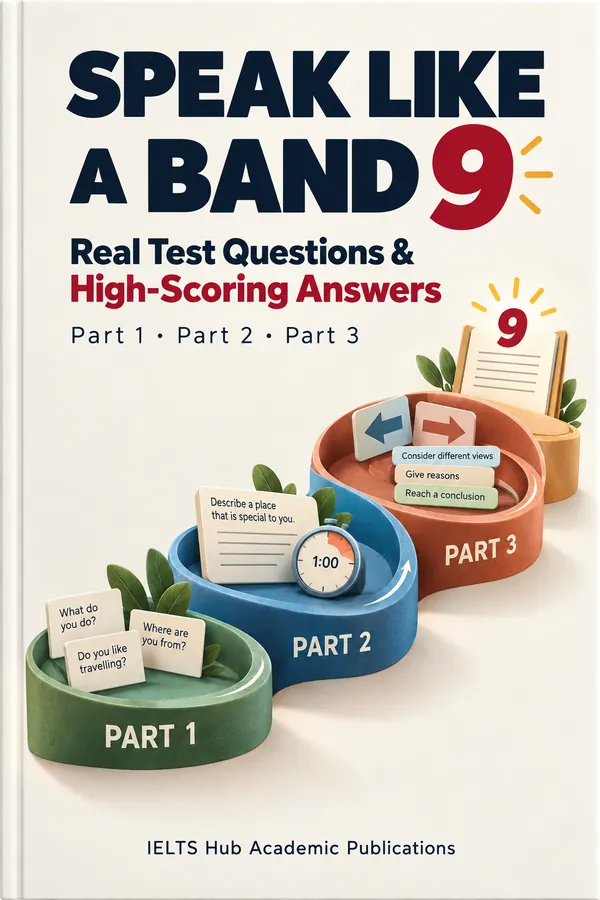
Speaking
Speak Like a Band 9
Real Test Questions & High-Scoring Answers
₹299$9.99CAD 13.99AUD 14.99£7.99NZD 16.99€8.99AED 39SGD 12.99

Speaking
Band 7+ Speaking Expressions
300 natural expressions for fluent, flexible speaking
₹199$6.99CAD 8.99AUD 9.99£4.99NZD 10.99€5.99AED 24SGD 8.99

Speaking
Speaking Tips for IELTS
Proven Strategies for Band 8.0+
₹299$9.99CAD 13.99AUD 14.99£7.99NZD 16.99€8.99AED 39SGD 12.99