Speaking test #782
Part 1 · Interview
4 to 5 minutes. The examiner asks about you and familiar topics.
Can you tell me your full name?
Where are you from?
Do you work or are you a student?
What kinds of things do you write by hand? [Why/Why not?
?] I write a variety of things by hand, such as notes, journal entries, and letters. I find that writing by hand allows me to process my thoughts in a different way and helps me to remember information better. It also has a certain level of personalization that typing on a computer cannot provide.
Do you prefer writing by hand or typing on a keyboard? [Why/Why not?
?] I prefer writing by hand because it allows me to have a more personal connection to the words I am writing. I also find that my handwriting is more legible and easier to read than my typing. However, I do appreciate the convenience and speed of typing when it comes to larger projects or work-related tasks.
Did you write more by hand when you were younger? [Why/Why not?
?] Yes, I wrote more by hand when I was younger because that was the primary method of writing in my school. We were encouraged to take notes and do our homework by hand, which helped me to develop my handwriting and note-taking skills.
When you write by hand, do you think in the same way as when you use a keyboard? [Why/Why not?
?] No, I do not think in the same way when I write by hand as when I use a keyboard. Writing by hand allows me to process my thoughts in a more organic and free-flowing manner, while typing on a keyboard is more structured and efficient. They each have their own unique benefits and I like to use them in different situations depending on my needs.
You will have to talk about the topic for one to two minutes. You have one minute to think about what you are going to say. You can make some notes to help you if you wish.
Describe someone who is your online friend
You should say:
- How you met them online
- What activities you do together online
- How often you communicate with them
- Your feelings about your online friendship
How you met them online
I'd like to talk about my online friend, Neha, whom I met through a language exchange platform about a year ago. We were both seeking partners to practice our respective languages, and that's how our friendship began. Neha is from India, like me, but from a different state, so we have the opportunity to learn about each other's cultures and languages.
What activities you do together online
We mostly communicate through video calls and messaging apps, where we help each other improve our language skills. Apart from language practice, we also share interesting stories about our daily lives, discuss current events, and even watch movies together online. It's amazing how technology has enabled us to connect and bond over shared interests despite the physical distance between us.
How often you communicate with them
We try to communicate at least a few times a week, even with our busy schedules. Sometimes we have long conversations that last for hours, while other times it's just a quick check-in to see how we are doing. Despite the virtual nature of our friendship, I feel a strong connection with Neha, and she has become an important part of my life.
Your feelings about your online friendship
Overall, I am grateful for my online friendship with Neha. It has not only helped me improve my language skills but also broadened my perspective on different cultures. I cherish the moments we spend together online and look forward to continuing this friendship for years to come.
- Words
- 231
- Sentences
- 12
- Words per sentence
- 19.3
- Speaking time
- about 1.8 min
Counted at 130 words a minute. The exam gives you one to two minutes.
Part 3 · Discussion
4 to 5 minutes. The examiner asks broader questions linked to the cue card topic.
What do you think is different about online friendships compared to regular friendships?
I believe the nature of online friendships vastly differs from traditional friendships, primarily due to the medium of communication. In online friendships, interactions often take place through social media or messaging apps, which can lead to a more casual and sometimes superficial connection. On the other hand, traditional friendships tend to be built on face-to-face interactions, allowing for deeper emotional connections and non-verbal cues that are often lost in digital conversations. Moreover, online friendships can sometimes facilitate a broader social network, enabling people to connect with individuals from different cultures and backgrounds, which can be incredibly enriching. However, I think there’s something irreplaceable about sharing experiences in person, like going for coffee or hanging out at a park, that really cements traditional friendships. Ultimately, both types of friendships have their unique qualities, and they can complement each other beautifully in today’s interconnected world.
How can someone see online friendships as not as important as in-person relationships?
That's an interesting question! Many people argue that online friendships can feel less authentic compared to face-to-face relationships. Firstly, the lack of non-verbal cues in online interactions can lead to misunderstandings, as we miss out on body language and tone of voice, which are crucial in conveying emotions. Additionally, online friendships might lack the depth and intimacy that often develop through shared experiences and physical presence. There’s also the concern that online interactions can foster a sense of superficiality, where relationships are based more on convenience rather than genuine emotional connection. Ultimately, while online friendships can certainly be meaningful, they might not carry the same weight as those formed in person.
How important are online friendships in today's social interactions, and what part do they play?
Online friendships play a pivotal role in today’s social dynamics, especially as our lives become increasingly digital. They offer a unique platform for people to connect regardless of geographical barriers, fostering a sense of community that might not be possible in traditional settings. These friendships can be particularly significant for those who feel isolated in their immediate environment, as they provide a space to share experiences and support one another. Moreover, they often encourage cultural exchange and broaden our perspectives, allowing us to engage with diverse viewpoints. In essence, while they may lack the physical presence of face-to-face interactions, the emotional support and understanding found in online friendships can be incredibly meaningful.
Why do you think more people are using online platforms to make friends?
I think the growing trend of forming friendships online can be attributed to several factors. Firstly, the sheer convenience of connecting with others from the comfort of one’s home is incredibly appealing; it breaks down geographical barriers that once limited social interactions. Moreover, many people find that they can express themselves more freely in online environments, which often leads to more meaningful connections. Additionally, with the rise of social media and various interest-based communities, individuals can easily find like-minded people who share their passions and hobbies. All of this creates a vibrant ecosystem where friendships can flourish, making it no surprise that so many are gravitating towards these digital platforms!
How could online friendships change in the next ten years?
The landscape of online friendships is likely to undergo some fascinating transformations over the next decade. With the rapid advancement of technology, I can envision a future where virtual reality and augmented reality play pivotal roles in how we connect with others. Imagine being able to meet friends in a digital space that feels remarkably real, sharing experiences as if you were physically together, even if you're miles apart. Additionally, as social media platforms continue to innovate, they may introduce new features that foster deeper connections, perhaps through enhanced interactive experiences or even AI-driven matchmaking based on interests and values. Overall, while the essence of friendship will remain, the ways we cultivate and maintain those connections are bound to become more immersive and meaningful.
What actions can people take to make sure their online friendships are important and satisfying?
To cultivate meaningful and fulfilling online friendships, individuals can start by being genuinely engaged in conversations with their friends. This means actively participating in discussions, asking thoughtful questions, and sharing personal experiences. It's essential to establish mutual trust, so being honest and open about one's feelings can go a long way. Additionally, setting aside time for virtual hangouts, whether through video calls or gaming sessions, can really strengthen those connections. Lastly, individuals should strive to nurture these relationships by regularly checking in and celebrating each other's milestones, making the friendship feel more authentic and valued.
Go further with the books
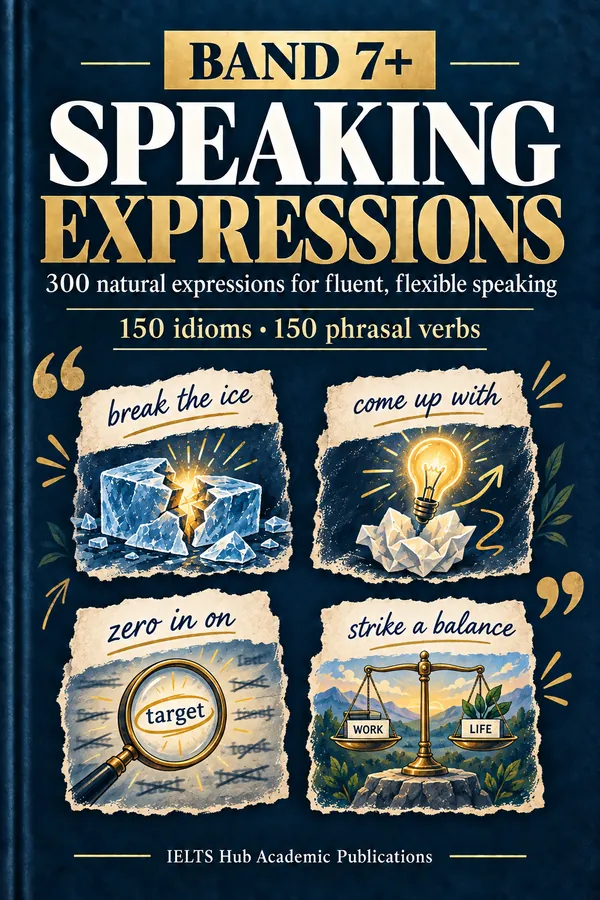
Speaking
Band 7+ Speaking Expressions
300 natural expressions for fluent, flexible speaking
₹199$6.99CAD 8.99AUD 9.99£4.99NZD 10.99€5.99AED 24SGD 8.99

Speaking
Speaking Tips for IELTS
Proven Strategies for Band 8.0+
₹299$9.99CAD 13.99AUD 14.99£7.99NZD 16.99€8.99AED 39SGD 12.99

Speaking
Speak Like a Band 9
Real Test Questions & High-Scoring Answers
₹299$9.99CAD 13.99AUD 14.99£7.99NZD 16.99€8.99AED 39SGD 12.99