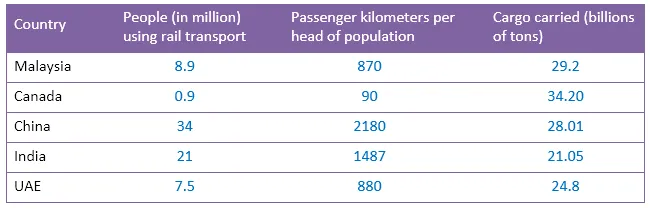
The table provides data on the railway system in five different nations in the year 2015.
At a glance, it can be observed that there are significant differences in the length of railway lines and the number of passengers using rail transport among the countries. The United States had the longest rail network, while Japan had the highest number of rail passengers.
In terms of railway length, the United States stood out with a total of 224,792 km, which was approximately four times longer than that of India, the country with the second longest rail lines. The other three countries, China, Russia, and Japan, had considerably shorter rail networks, with Japan having the least at 27,182 km.
Conversely, when considering the number of rail passengers, Japan was the clear leader with 22.3 billion passengers, far surpassing the other countries. The United States, despite having the longest railway lines, only carried 992 million passengers, the lowest among the five nations. Meanwhile, China and India had a similar number of passengers, at around 2.8 billion and 2.5 billion respectively, whereas Russia had slightly fewer passengers at 1.1 billion.