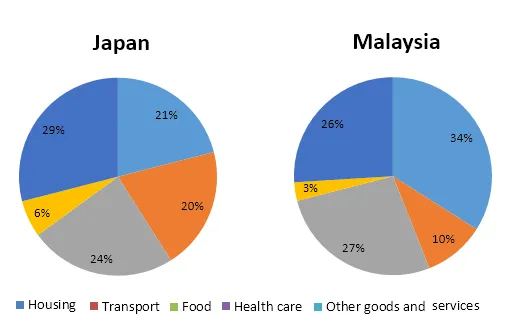
The pie diagrams illustrate the proportion of average household spending on various categories in Japan and Malaysia in the year 2010.
At a glance, it can be seen that food was the largest expense in both countries, while the least amount of money was spent on health care in Japan and on education in Malaysia. Interestingly, the distribution of expenses varied significantly between the two nations.
In Japan, food accounted for a third of household spending, followed by housing at 21%. Transport and other goods and services each made up 16% of the expenditure, while only 7% was allocated to health care. In contrast, education and clothing received the least financial attention, each comprising 4% of the total spending.
On the other hand, Malaysian households spent slightly less on food, which made up 27% of their total expenditure. Housing and transport were also significant expenses, accounting for 23% and 20% respectively. Other goods and services represented 18% of spending, while clothing and health care each accounted for 7%. Interestingly, the smallest proportion of household expenditure in Malaysia was on education, at a mere 2%.