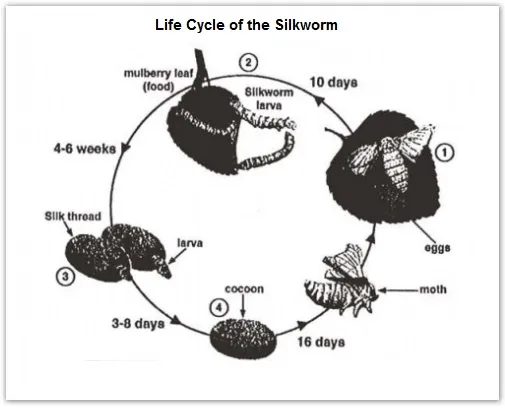
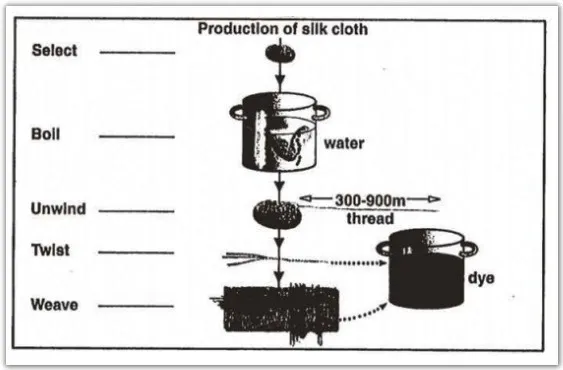
The provided illustrations delineate the life progression of a silkworm and the subsequent phases involved in the fabrication of silk material.
The life cycle of the silkworm is a natural process that consists of four stages, starting from the egg and ending with the moth phase. In contrast, the production of silk cloth is a human-controlled process that involves several steps, beginning with the selection of cocoons and culminating in the creation of the final product.
The life cycle of the silkworm begins with eggs, which hatch into larvae. The larvae then feed on mulberry leaves for approximately 42 days, after which they spin cocoons around themselves. After a period of 16 days, a moth emerges from the cocoon, completing the cycle.
The silk cloth production process starts with the selection of cocoons, which are then boiled in water. The silk threads are unwound from the boiled cocoons and twisted to form a thicker strand. These strands are dyed and woven to produce the final silk cloth.