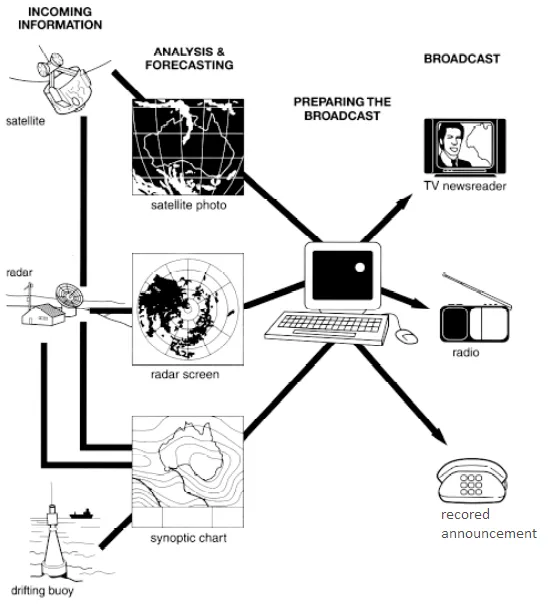
The provided diagram illustrates the process by which the Australian Bureau of Meteorology gathers real-time weather data to generate trustworthy weather predictions.
At a glance, the process involves collecting data from various sources, processing this information through supercomputers, and then disseminating the resultant forecasts to the public. The procedure is cyclic, indicating a continuous monitoring of weather conditions.
Delving into the details, the first part of the process involves the collection of data from four main sources: satellites, radar, drifting buoys, and automatic weather stations. These sources provide comprehensive coverage, from space-based observations to detailed local readings. The collected data is then transmitted to the bureau where it is processed.
The second part of the process involves the use of supercomputers at the bureau to process the received data. These computers analyse the data to produce weather forecasts. These forecasts are then broadcasted to the public through various mediums, including television, radio, and the Bureau's website. The process is ongoing, ensuring the most current weather information is always available.