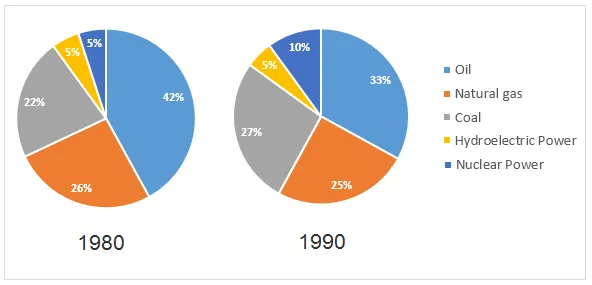
The dual charts illustrate the principal energy sources in the United States during the 1980s and 1990s.
From a broad perspective, it can be observed that while some energy sources witnessed a rise in their usage over the decade, others experienced a decline. Moreover, oil was the most utilized energy source in both decades, albeit with a slight decrease in the latter decade.
In the 1980s, oil accounted for over half of the energy sources, at 52%. Natural gas and coal followed at 20% and 22% respectively, while nuclear power and other sources contributed a mere 5% and 1%. However, the 1990s saw a shift in this pattern. While oil remained the dominant source, its share reduced to 47%. Natural gas saw a slight increase to 21%, whereas coal's contribution remained relatively stable at 23%.
Interestingly, the most significant change was seen in the use of nuclear power, which doubled to 10% in the 1990s. Other sources also experienced a slight increase, contributing 3% to the total energy sources. This indicates a gradual shift towards diverse energy sources during this period.