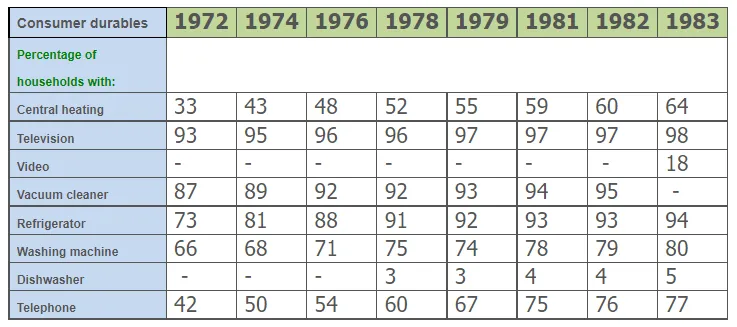
The table provides information on various socio-economic parameters for four different nations as per the data collected by the United Nations in 1994.
A broad observation of the data reveals significant disparities among the countries in terms of population, gross national product (GNP), and daily calorie supply. Furthermore, it is evident that the literacy rate varies considerably between these nations.
Looking closely, India had the largest population of the four countries, with 952 million people, which was significantly higher than Brazil's 160 million. However, Brazil had a higher GNP per capita at $3,500 compared to India's $1,100. Interestingly, both countries had the same daily calorie supply per person at 2,700.
On the other hand, China, with a population of 1,200 million, had a GNP per capita of $2,500 and a daily calorie supply of 2,600 per person. Despite having a smaller population of 39 million, Argentina had a higher GNP per capita at $8,400 and a higher daily calorie supply at 3,100. The literacy rates varied greatly, with Argentina leading at 96.1%, followed by Brazil at 84.2%, China at 78%, and India lagging behind at 52%.