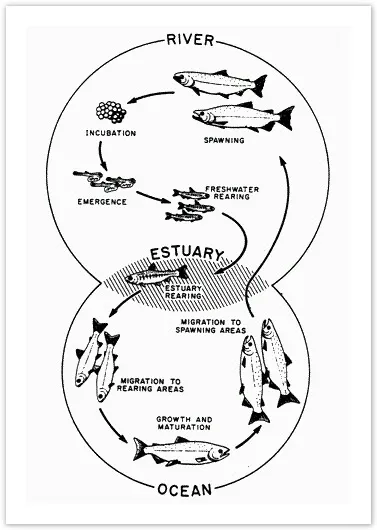
The diagram illustrates the various stages in the life cycle of a salmon, commencing as an egg and culminating in its maturity as an adult fish.
The life cycle of a salmon is a circular process with no starting point, but for the purpose of this report, it will begin with the egg stage. It is noteworthy that the cycle involves several transformations, including a period in fresh water, a journey to the sea, and a return to fresh water.
Initially, the life of a salmon begins in fresh water when it hatches from an egg as an alevin. Subsequently, it grows into a fry and then into a parr with distinctive vertical stripes. After one to five years, the parr transforms into a smolt, loses its stripes, and prepares for the journey to the sea.
Once in the ocean, the smolt evolves into a silvery adult salmon over a period of one to five years. Remarkably, the adult salmon then undertakes an arduous journey back to its birthplace in fresh water to spawn and lay eggs, thereby completing the cycle. After spawning, some salmon die, but others may return to the sea and repeat the cycle.